
Ratan Tata: Early Life, Career, Love & Achievements
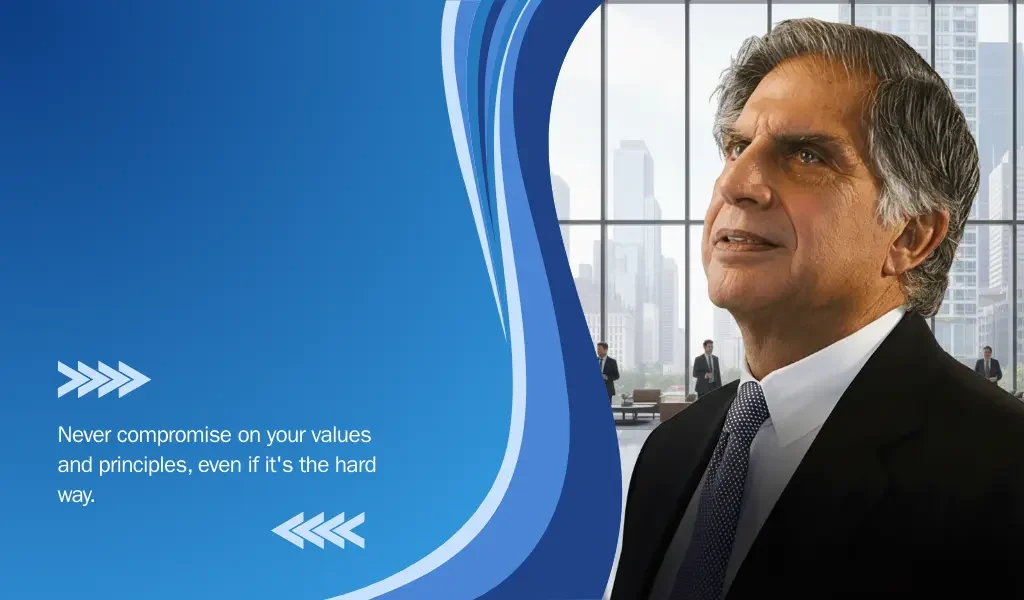
From Loneliness to Legacy – The Untold Story of India’s Most Beloved Industrialist
December 28, 1937. The esteemed Tata family welcomed a baby boy into the world. However, wealth was insufficient to protect young Ratan from the suffering that would mold his personality. His parents divorced when he was only ten years old. During those difficult childhood years, his grandmother, Navajbai Tata, became his pillar of support.
Growing up in Mumbai’s Tata Palace on Pedder Road, Ratan Naval Tata discovered something that most affluent children never do: money cannot buy happiness or make up for the absence of parents. Millions of Indians would eventually find compassion as a result of this early heartbreak.
The Education That Built a Visionary
Ratan went to some of the best schools in India. After completing his education at Mumbai’s Campion School, he transferred to Cathedral and John Connon School. But when he moved to America in the 1950s from India, his true education started.
He studied structural engineering and architecture at Cornell University, where he earned his degree in 1962. Ratan’s decision may seem strange for someone destined to run an industrial empire, but it reveals an important aspect of his personality: he was always concerned with creating long-lasting structures and enterprises.
He didn’t end there. In 1975, he began the Advanced Management Program at Harvard Business School. At that point, he had already worked on the shop floors of Tata companies for years, learning the business from the ground up.
Beginning at the Bottom
Ratan joined Tata Steel in 1961, right after graduating from Cornell. But there were no corner offices ready for him. He worked with the people in Jamshedpur, shoveling limestone and taking care of blast furnaces. It didn’t matter that he went to a fancy school; that’s exactly how JRD Tata, his mentor, wanted it.
Many of his coworkers didn’t even know he was a Tata. He stayed in a simple guest house, ate in the workers’ cafeteria, and learned that he had to earn respect instead of demanding it because of his last name.
He later worked for Tata Motors and other companies in the group. He learned something new on every job, like how to make things, run a business, manage people, and most importantly, people. He spent years in relative obscurity getting ready for a role he wasn’t sure he’d get.
The Unexpected Rise to Power
A lot of people thought that Darbari Seth or another senior executive would take over when JRD Tata stepped down as chairman in 1991. People in business were shocked when Ratan Tata, who was 53 years old at the time, was made chairman of Tata Sons.
The first few years were hard. A lot of the heads of the group companies, who were older and more experienced, didn’t want to follow his orders. The Tata Group was made up of separate kingdoms, and the young chairman wanted to bring them all together under one vision.
He had to make hard choices. He fired a number of company chairmen who wouldn’t go along with the group’s plans. Ratan knew that change is never easy, so he had to be brave and deal with the critics.
Building an Empire for India
The Tata Group underwent a radical transformation under his direction from 1991 to 2012.The company’s revenue went up by more than 40 times, reaching over $100 billion. But numbers don’t tell the whole story.He bought Tetley Tea in 2000 for $450 million, which was the first big purchase of a British brand by an Indian company. When people asked about the price, Ratan saw something that others didn’t: India’s place in the world.When Tata Steel bought Corus for $12 billion in 2007, it became one of the world’s largest steel producers. Tata Motors bought Jaguar Land Rover for $2.3 billion in the same year. Currently, JLR is one of the Tata empire’s most prosperous divisions.
The Ford Revenge Story: From Insult to Victory
Ratan started the Tata Indica in 1998. It was India’s first passenger car made in India.When initial sales disappointed, Ford Motor Company offered to buy the struggling division. In 1999, Ratan and his team flew to Detroit to meet Bill Ford.What happened next became legendary.Bill Ford humiliated them. In front of Ratan’s entire team, Ford asked condescendingly, “Why did you start the car business when you know nothing about it? We’re doing you a favor by buying your failing division.”On the flight back, Ratan sat in silence, processing the disrespect. But inside that silence brewed determination. Back in India, he shocked everyone by refusing to sell. Instead, he improved the Indica and proved Ford wrong.
Fast forward to 2008. The global recession crushed America. Ford, drowning in twelve billion dollars of losses, faced bankruptcy. They desperately needed to sell assets, including Jaguar and Land Rover.Ratan saw his moment. In March 2008, Tata Motors acquired Jaguar Land Rover for $2.3 billion. The same Bill Ford who had insulted him nine years earlier now flew to Mumbai, to Bombay House where it all began.During signing, Bill Ford said: “You are doing us a big favor by buying Jaguar Land Rover.”The tables had turned completely. But Ratan didn’t gloat or remind Ford of that humiliating meeting. He treated them with dignity, showing that true class lies in grace, not revenge.
Under Tata’s ownership, JLR experienced a stunning turnaround. Sales grew from ten billion pounds in 2011 to over twenty-five billion by 2018. The brands Ford couldn’t make profitable became jewels in Tata’s crown, generating massive profits and establishing Indian business superiority globally.
This wasn’t just business—it was a statement. Never underestimate Indian entrepreneurs. Being embarrassed can make you more determined, which can lead to great things. This story of revenge became a symbol of Indian business success and winning over disrespect through smart planning. This story of revenge became a symbol of both strategic victory over disrespect and business success in India.
The Dream Called Nano
The Tata Nano was Ratan’s biggest and most emotional project. On a rainy night, he saw a family of four trying to get through traffic on a scooter that was very unstable. He couldn’t get that picture out of his head.He wanted to give regular Indians a car that was safe and cheap.The Nano was released in 2008 and costs one lakh rupees, or roughly one thousand two hundred fifty dollars.It wasn’t as successful at the box office as expected, but it was about a billionaire who was concerned about the safety and dignity of regular people.
The Unfulfilled Love Story
There was a man behind the successes who had a heart full of unfulfilled desire. In a few interviews, Ratan revealed that he nearly married four or five times, but obstacles consistently stood in his way.
He fell deeply in love once while working for Tata in Los Angeles. But the woman’s parents didn’t want her to move to India. The end of the relationship left an indelible scar.He was about to get married when the 1962 India-China war broke out. His fiancée’s parents didn’t want her to marry him because they were worried about the future.
Ratan never got married. When people asked him about this, his eyes showed a mix of regret and acceptance. He once said that he sometimes thought about how different his life would have been if he had a family. But work took up all of his time, and over time, loneliness became his friend.
The Man Behind the Business
People who knew Ratan personally say he was very different from how he looked in public. He liked dogs more than most people and often chose to spend time with them instead of going to social events. He started his Instagram account in his 80s and posted pictures of his beloved pets. This showed a softer side of him that the boardroom never saw.
He drove himself to work in a simple sedan, lived in a simple apartment even though he had billions, and answered his own emails. He has helped many people he didn’t know, like paying for someone’s medical care, funding a student’s education, or just stopping to help someone whose car broke down.
He kept his door open at Tata’s headquarters, Bombay House. Anyone who worked there, no matter what their rank, could come in with ideas or problems. This level of access was a game changer in India’s corporate culture, which is based on hierarchy.
Legacy Beyond Profits
Ratan left behind more than just a corporate empire when he resigned as chairman in 2012. Since philanthropic trusts own 66% of Tata Sons’ equity, the company’s profits are primarily allocated to rural development, healthcare, and education.
Over 700,000 people work for the Tata Group globally. However, Ratan’s true legacy is found in innumerable medical facilities, educational institutions, and research centers that were established thanks to Tata philanthropy.
In 2008, he was awarded India’s second-highest civilian honor, the Padma Vibhushan.
But when people asked him about his achievements, he often talked about things like honesty, humility, and giving back.
The Final Chapter
Ratan returned as interim chairman after Cyrus Mistry’s controversial firing in 2016 and stayed in that role until 2017. This showed that even in his late seventies, when his companies needed him, he was always there for them.
Ratan Tata died on October 9, 2024, when he was 86 years old. People in India were sad like they had lost a family member. Everyone, from millionaires to street vendors, had a story about Ratan Tata. He did kind things, helped people, and made quiet donations that changed lives.
What He Taught Us
Ratan Tata demonstrated that success devoid of values is insubstantial. That power should be used with care. That real wealth is measured by the lives you touch, not the amount of money you have in the bank. He showed that you can be very successful and still be very humble.
He never had kids, but millions of people looked up to him as a father figure. He never got married, but his love for India and Indians was stronger than most relationships. He lived simply, worked hard, and was very generous.
In a time of flashy billionaires and corporate scandals, Ratan Tata stood out. He showed that business can be a force for good, that leaders can be servants, and that the best life is one spent helping others.
His rise from being a lonely child to India’s most famous businessman was more than just a business story. It showed character, kindness, and the belief that we get ahead by helping others. The memory of a kind man who built an empire but never lost his humanity will live on long after all of his business successes.